


Anomaly-based threat detection requires a baseline to measure against and that is supplied by UEBA. We explain the methodology.
User Entity Behavior Analytics (UEBA) is a cybersecurity approach focused on monitoring and analyzing the behavior of users and entities (such as devices, applications, or services) within an organization’s IT environment. Unlike traditional security systems that rely heavily on predefined rules or signature-based methods, UEBA leverages advanced analytics and machine learning to detect anomalies and potential threats based on deviations from established behavior patterns. Here’s a detailed look at UEBA, its components, and its benefits.
Understanding UEBA
UEBA is designed to enhance security by focusing on the behavior of users and entities rather than just on static data or known threats. It uses data from various sources, including log files, network traffic, and user activities, to build a baseline of normal behavior. This baseline helps identify deviations that might indicate malicious activities or insider threats.
Components of UEBA
- Data Collection UEBA systems gather data from a variety of sources, including user logins, file accesses, email communications, network traffic, and application usage. This data is aggregated into a central repository for analysis.
- Behavioral Baselines The collected data is used to establish a baseline of normal behavior for users and entities. This involves analyzing historical data to understand typical patterns, such as usual login times, frequent access points, or typical data transfer volumes.
- Behavioral Analytics Machine learning and statistical models are applied to the baseline behavior to detect anomalies. For example, if a user who typically accesses files during office hours suddenly starts accessing many files late at night, this could be flagged as unusual behavior.
- Anomaly Detection The system continuously monitors real-time data against the established baseline. When it detects deviations that exceed predefined thresholds or are statistically significant, it triggers alerts for further investigation.
- Contextual Analysis UEBA solutions provide contextual information about anomalies, such as the user’s role, recent activities, and associated risk factors. This helps security teams understand the potential impact and determine whether the anomaly is a benign anomaly or indicative of a security threat.
- Incident Response Upon detecting suspicious behavior, UEBA tools can integrate with incident response systems to automate or facilitate further investigation and remediation processes. This can include isolating affected systems, conducting forensic analysis, or notifying relevant personnel.
Benefits of UEBA
User and Entity Behavior Analytics (UEBA) offers significant benefits by enhancing an organization’s security posture. It leverages machine learning and advanced analytics to establish behavioral baselines for users and entities, enabling the detection of anomalies that may indicate insider threats, compromised accounts, or other malicious activities. Its benefits fall into the following categories:
- Improved Threat Detection Traditional security systems often struggle to detect insider threats or advanced persistent threats because they rely on known signatures or static rules. UEBA, on the other hand, uses behavioral analytics to detect anomalies that may indicate sophisticated or novel attacks, including those that do not match known attack patterns.
- Enhanced Visibility UEBA provides comprehensive visibility into user and entity behavior, offering insights into activities across different systems and applications. This holistic view helps security teams identify suspicious patterns that might not be visible when monitoring isolated data points.
- Reduced False Positives By establishing a baseline of normal behavior, UEBA systems reduce the number of false positives compared to traditional security tools. Anomalies that trigger alerts are assessed in the context of established behavior, helping differentiate between genuine threats and benign anomalies.
- Insider Threat Detection UEBA is particularly effective at identifying insider threats, such as employees misusing their access privileges or exhibiting unusual behavior that could indicate malicious intent. By focusing on deviations from normal behavior, UEBA can detect insider threats that might bypass other security measures.
- Adaptive and Scalable UEBA systems adapt to changes in user and entity behavior over time, improving their accuracy and relevance. As organizations grow and evolve, UEBA solutions can scale and adjust their models to reflect new patterns and emerging threats.
- Contextual Insights UEBA tools provide valuable context around detected anomalies, enabling security teams to prioritize and investigate incidents more effectively. Contextual information helps in understanding the potential impact of an anomaly and informs appropriate response actions.
Challenges and Considerations
Challenges of UEBA include data privacy concerns, integration complexity, false positives, scalability issues, and the need for continuous tuning and updates. In detail:
- Data Privacy Collecting and analyzing user behavior data raises privacy concerns, especially if the data includes sensitive or personal information. Organizations must ensure compliance with data protection regulations and implement safeguards to protect user privacy.
- Complexity Implementing and managing UEBA systems can be complex, requiring significant expertise in data analytics, machine learning, and cybersecurity. Organizations need to invest in skilled personnel and resources to effectively deploy and maintain UEBA solutions.
- Integration Integrating UEBA tools with existing security infrastructure and workflows can be challenging. Ensuring that UEBA systems work seamlessly with other security tools and processes is crucial for maximizing their effectiveness.
- False Negatives While UEBA reduces false positives, it may still produce false negatives, where genuine threats are not detected. Continuous tuning and monitoring of the UEBA system are required to minimize these risks.
Tools for UEBA
User and Entity Behavior Analytics (UEBA) tools are essential for detecting anomalous behavior and hidden threats within an organization. These tools leverage machine learning, data science, and pattern recognition to establish behavioral baselines and identify deviations that may signal security incidents:
1. ManageEngine ADAudit Plus – FREE TRIAL
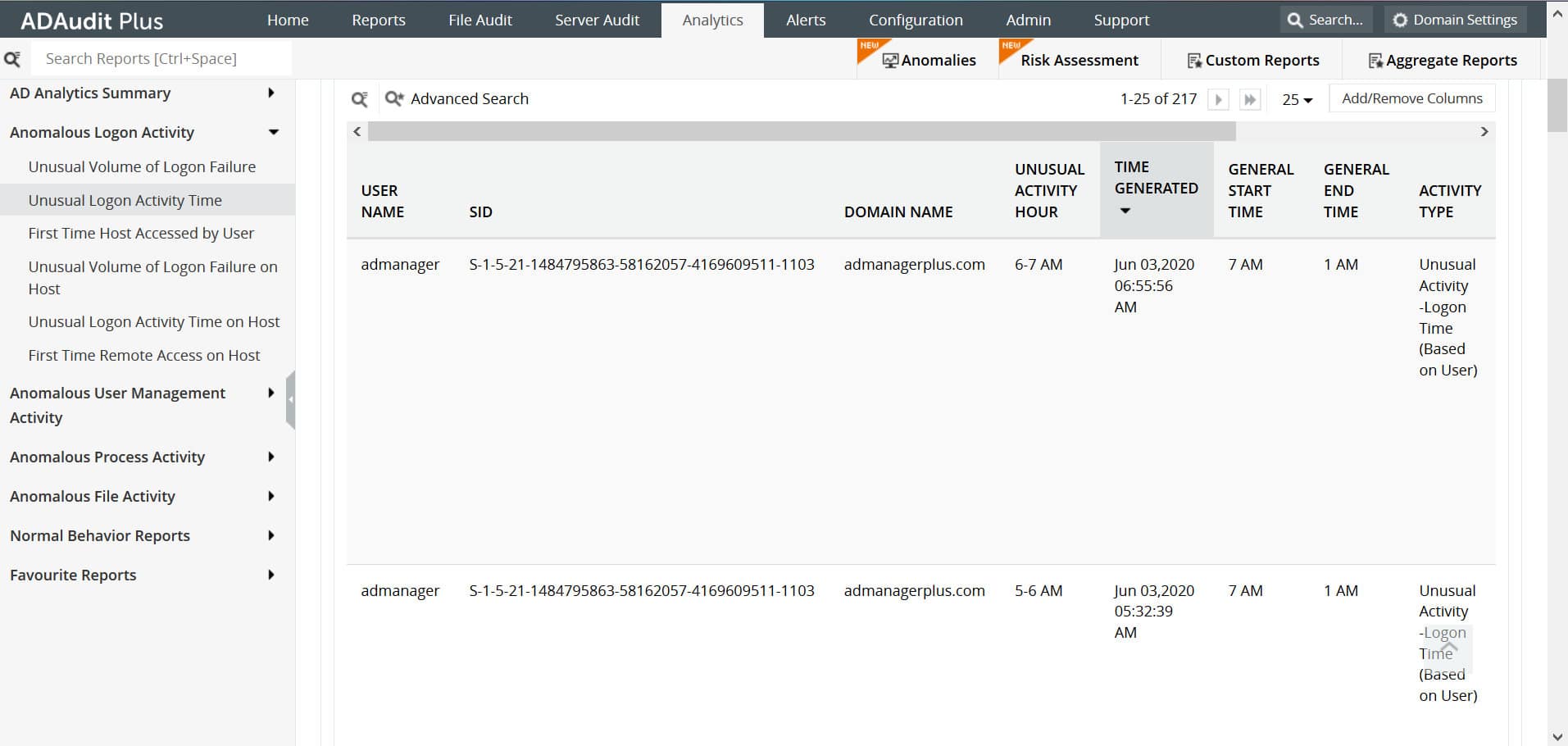
ManageEngine ADAudit Plus protects systems, particularly files, against corruption or theft. The tool looks at the capture or misuse of user accounts that are managed by Active Directory. It uses User and Entity Behavior Analytics (UEBA) to build a model of standard behavior per account and then identify anomalous activity that could indicate an insider threat or an account takeover.
Key Features:
- Real-time Monitoring: Tracks user activities and changes in real-time across Active Directory, file servers, and workstations.
- Anomaly Detection: Uses machine learning to identify unusual patterns and behaviors that could indicate potential security threats.
- Detailed Reports: Generates extensive reports on user activities, helping in compliance and audit requirements.
- Alerting System: Sends instant alerts for suspicious activities, enabling quick response to potential threats.
- User Behavior Analysis: Establishes baselines for normal user behavior and detects deviations from these baselines.
ManageEngine ADAudit Plus is particularly useful for organizations looking to enhance their security posture by closely monitoring user activities and detecting insider threats. You can register for a 30-day free trial.
2. Exabeam
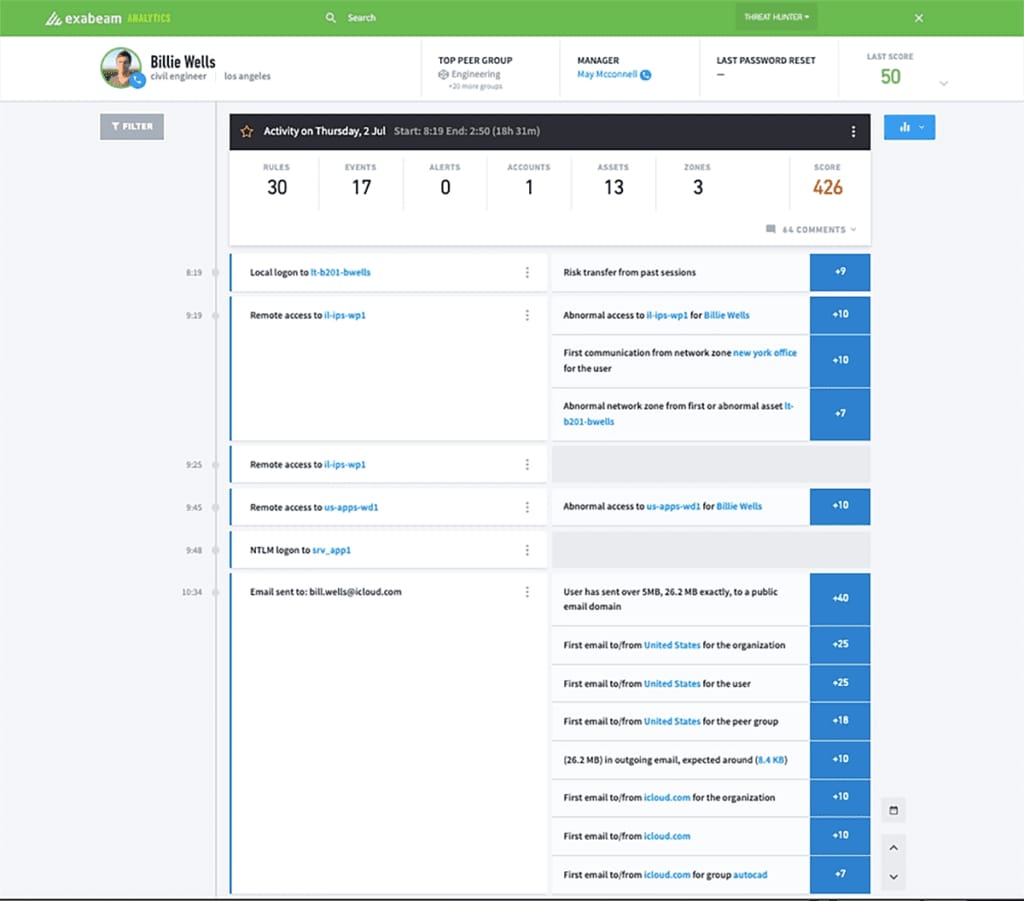
Exabeam is a leading security management platform known for its advanced User and Entity Behavior Analytics (UEBA). It leverages AI and machine learning to detect and respond to security threats.
Key Features:
- Behavior Baselines: Exabeam establishes normal behavior patterns for users and entities, making it easier to detect anomalies and potential threats.
- Risk Scoring: It assigns risk scores to events based on their deviation from established baselines, helping prioritize incidents that need immediate attention.
- Automated Incident Response: Exabeam automates the collection of evidence and organizes it chronologically, streamlining the investigation process.
- Integration with SIEM: It can augment existing SIEM solutions, enhancing their capabilities with advanced behavioral analytics.
- Machine Learning Models: Exabeam uses machine learning to continuously improve its detection algorithms, ensuring that they stay effective against evolving threats.
These features make Exabeam a powerful tool for identifying and mitigating security risks within an organization.
3. Rapid7 InsightIDR
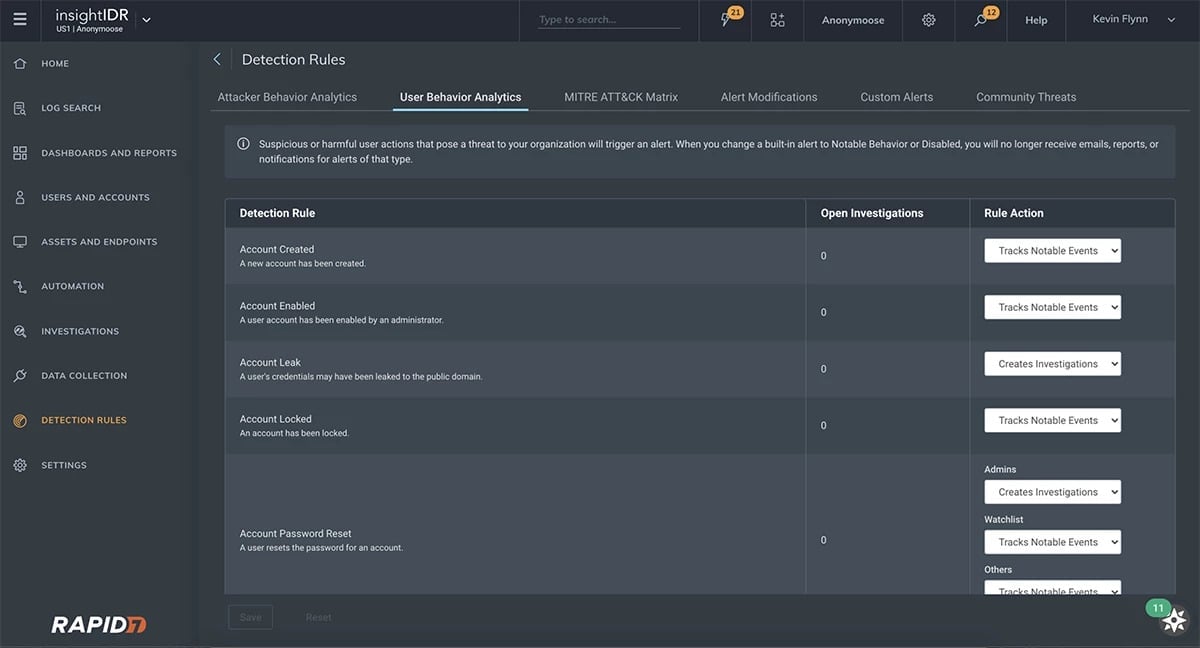
Rapid7 InsightIDR is a next-gen SIEM platform that integrates User and Entity Behavior Analytics (UEBA) to enhance threat detection and response.
Key Features:
- Behavior Baselines: InsightIDR continuously establishes baselines for normal user activity, making it easier to detect anomalies and potential threats.
- Risk Scoring: It assigns risk scores to events based on their deviation from established baselines, helping prioritize incidents that need immediate attention.
- Automated Incident Response: InsightIDR automates the collection of evidence and organizes it chronologically, streamlining the investigation process.
- Integration with SIEM: It can augment existing SIEM solutions, enhancing their capabilities with advanced behavioral analytics.
- Machine Learning Models: InsightIDR uses machine learning to continuously improve its detection algorithms, ensuring it stays effective against evolving threats.
These features make Rapid7 InsightIDR a leading tool for identifying and mitigating security risks within an organization.
4. Microsoft Sentinel
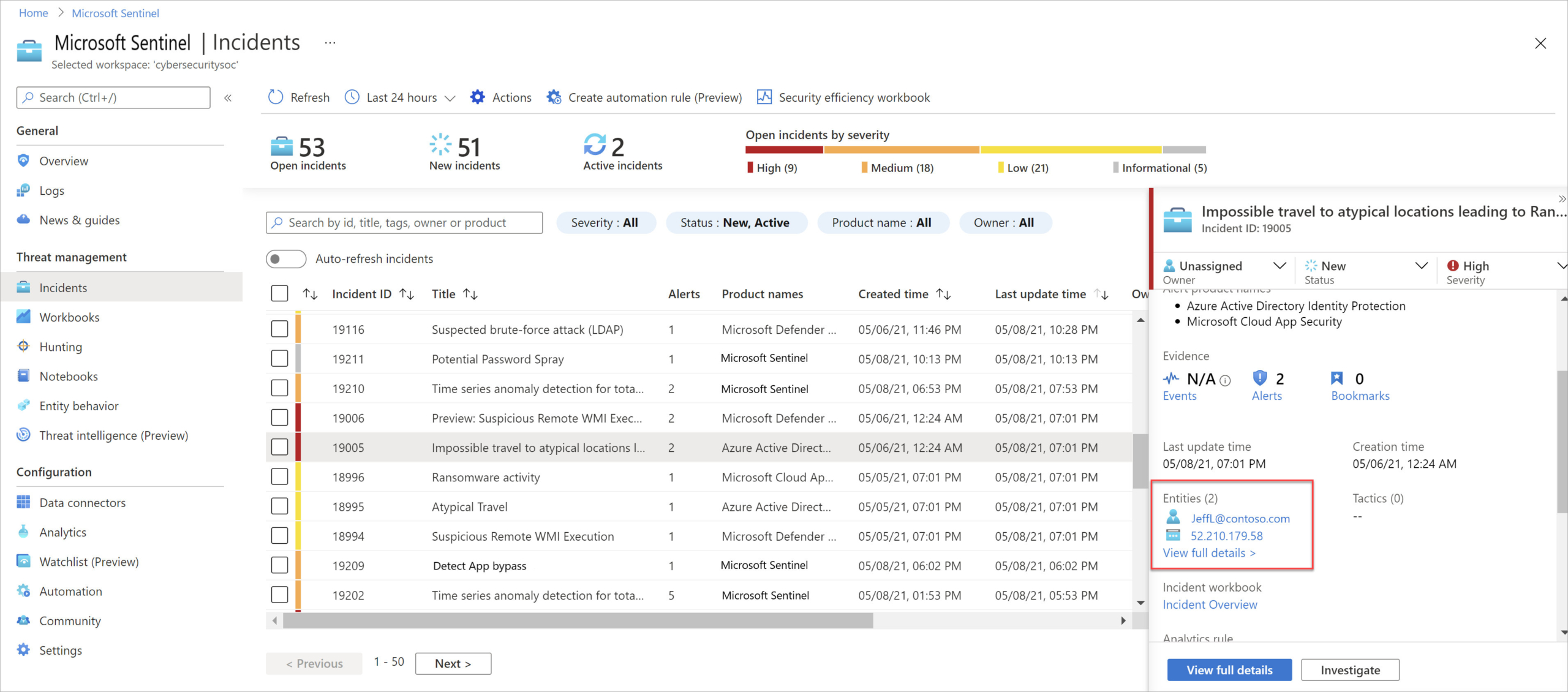
Microsoft Sentinel is a cloud-native security information and event management (SIEM) solution that includes User and Entity Behavior Analytics (UEBA) capabilities for baselining in its anomaly detection system.
Key Features:
- Behavioral Baselines: Establishes normal behavior patterns for users and entities. Analyzes logs and alerts to identify anomalies and potential threats.
- Anomaly Detection: Uses machine learning to detect unusual activities that deviate from established baselines, identifying compromised entities or malicious insiders.
- Risk Scoring: Assigns risk scores to detected anomalies, allowing security teams to prioritize incidents based on their potential impact.
- Integration with Microsoft Ecosystem: Integrates with other Microsoft security tools, providing a unified platform for security monitoring and incident response.
- Automated Incident Response: Collects and organizes evidence, streamlining the investigation process and reducing the time to respond to threats.
These features make Microsoft Sentinel a powerful tool for enhancing an organization’s security posture by providing deep insights into user behavior and enabling proactive threat detection.
5. Splunk User Behavior Analytics (UBA)
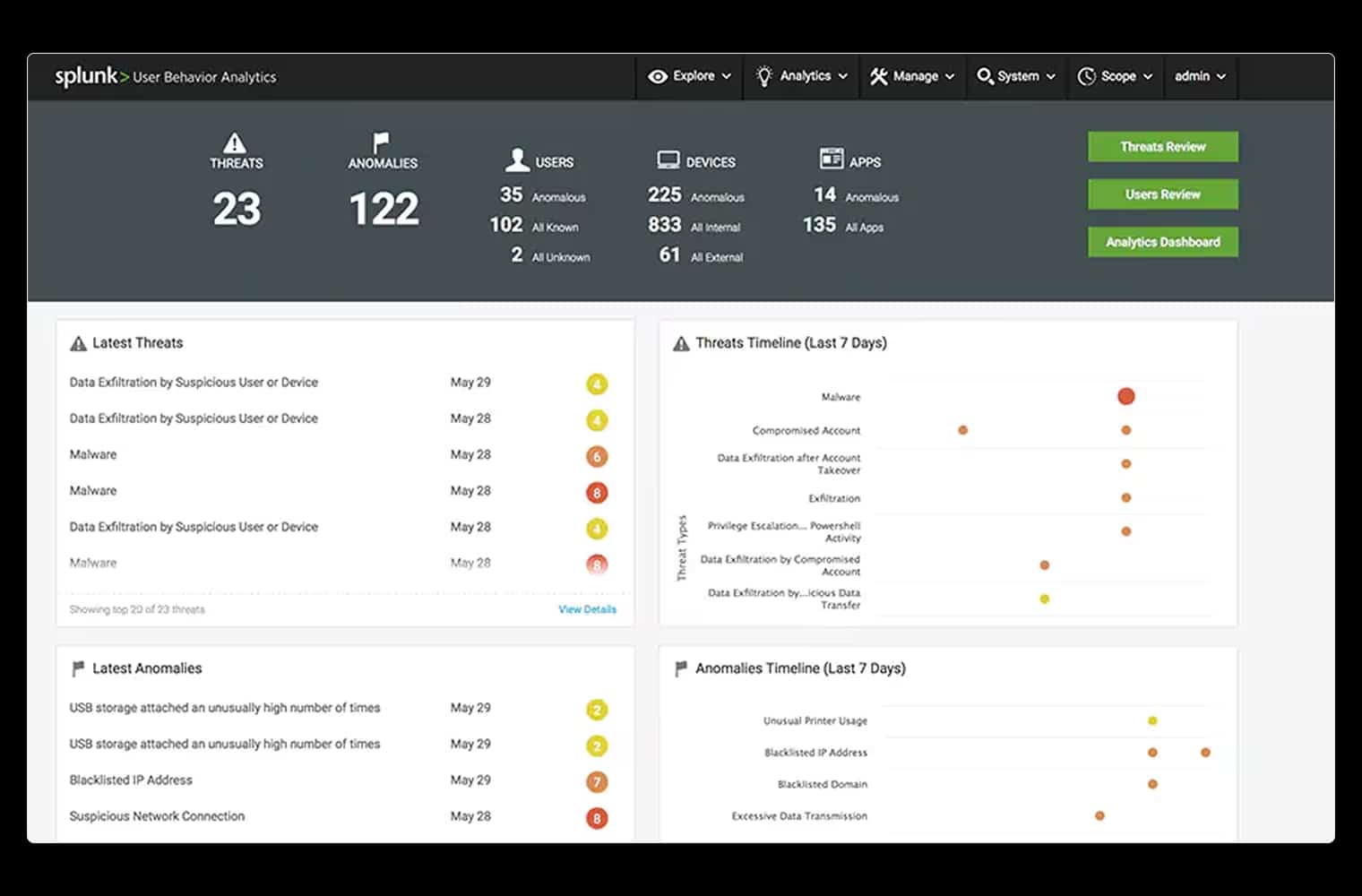
Splunk User Behavior Analytics (UBA) detects advanced threats and anomalous behavior using machine learning and behavior modeling. It fits into the Splunk security ecosystem, enhancing its capabilities to provide comprehensive security monitoring and incident response.
Key Features:
- Behavior Modeling and Baselines: Establishes baseline behaviors for users, devices, and applications, supporting the detection of potential threats.
- Anomaly Detection: Utilizes unsupervised machine learning algorithms to identify unusual patterns and behaviors and uncover hidden threats and insider attacks.
- Threat Visualization: Provides a context-rich view of threats across multiple phases of an attack, identifying the root cause, scope, severity, and timelines of incidents.
- Streamlined Threat Workflow: Reduces billions of raw events to a manageable number of threats for quick review and resolution, improving efficiency.
- Integration with Splunk Enterprise Security (ES): Works in conjunction with Splunk ES to create an investigative workflow for the overall security posture.
These features make Splunk UBA an integral part of the Splunk security system, providing deep insights into user behavior and enabling proactive threat detection and response.
6. Securonix
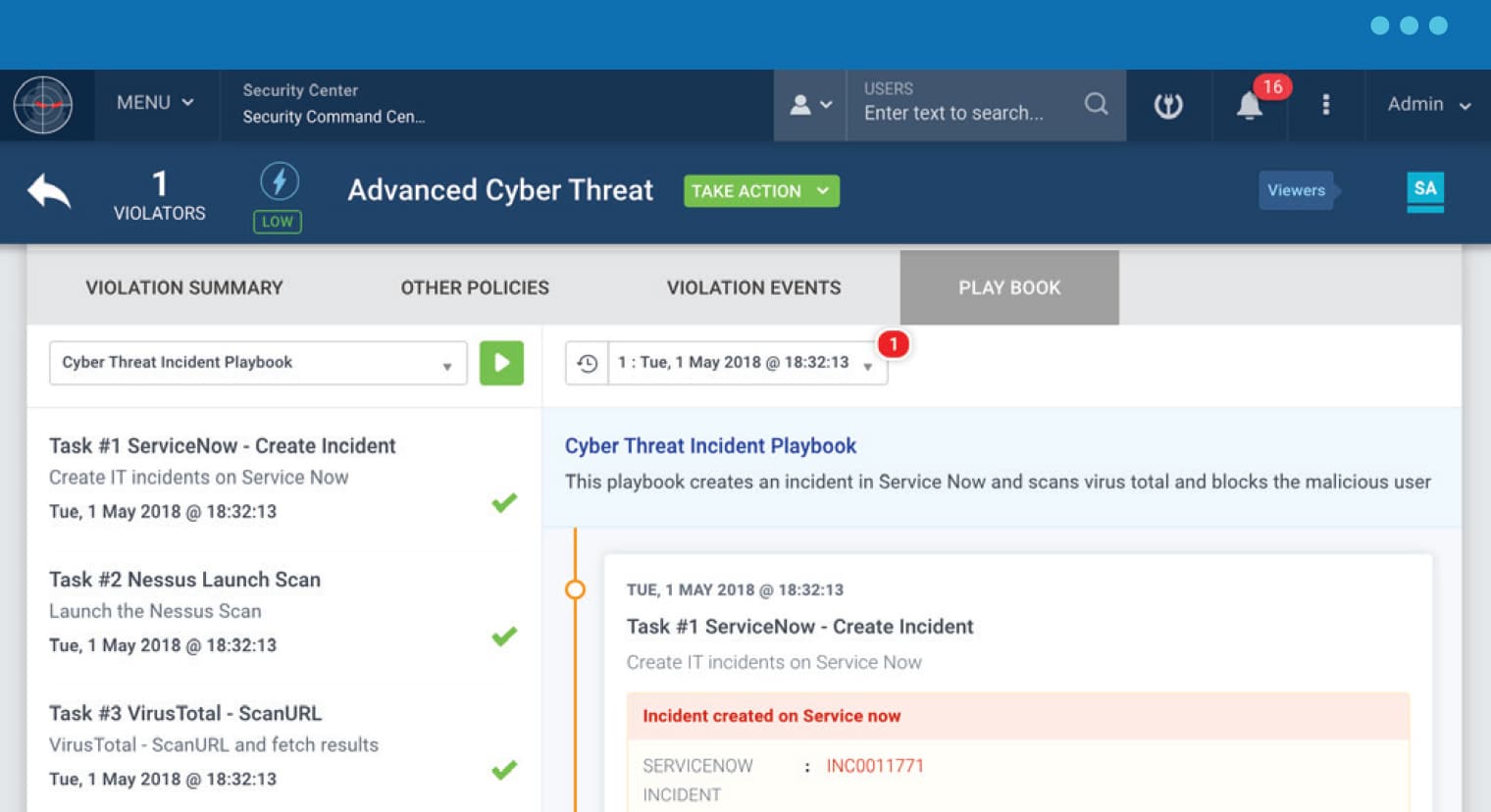
Securonix is a leading security analytics and operations management platform that excels in User and Entity Behavior Analytics (UEBA) and also offers Security Orchestration, Automation, and Response (SOAR).
Key Features:
- Advanced Anomaly Detection: Uses machine learning to detect unusual patterns and behaviors, identifying insider threats, cyber threats, and fraud with high accuracy.
- Behavior Baselines: Establishes normal behavior patterns for users and entities, making it easier to detect deviations that may indicate potential security incidents.
- Risk Scoring: Assigns risk scores to detected anomalies, helping security teams prioritize incidents based on their potential impact.
- Integration with SIEM: Seamlessly integrates with existing SIEM solutions, enhancing their capabilities with advanced behavioral analytics.
- Automated Response: Provides built-in automated response playbooks and customizable case management workflows, enabling quick threat response.
These features make Securonix a powerful tool for enhancing an organization’s security posture by providing deep insights into user behavior and enabling proactive threat detection and response.
Conclusion
User Entity Behavior Analytics (UEBA) represents a significant advancement in cybersecurity, offering a sophisticated approach to threat detection and incident response. By focusing on behavior patterns and leveraging advanced analytics, UEBA enhances an organization’s ability to identify and respond to both internal and external threats. Despite its benefits, organizations must carefully consider data privacy, complexity, and integration challenges to effectively leverage UEBA as part of their overall security strategy.
The UEBA strategy is becoming a standard mechanism in cybersecurity tools. For example, its inclusion is definitive in the advancement of SIEM systems into “next-generation” tools. The same is true for the advancement of EDR to ZDR in malware detection. So, whether you realize it or not, your organization may well be using UEBA already.
